In
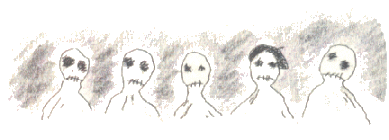
the poem "Brie Boy", Brie Boy is a young child with a round of brie
cheese for a head. None of the other children allowed Brie Boy to play with
them because he is so different. At the same time, in the last line of the poem
it says “but at least he went well with a nice chardonnay.” I think through
this poem Tim Burton is trying to make the statement that society can either
choose to reject something or someone that is seen as strange and unusual or it
can choose to accept this difference. I also think that he is trying to make
the statement about societies tendencies towards the artist. Many times an
artist is rejected because they may create things that are out of the norm,
like how Disney rejected Tim Burton’s drawings because they were not the normal
happy, cheerful Disney drawings everyone was used to. On the contrary, society
also has a tendency to use artists because of how different they seem. The
example of this in “Brie Boy” is that at first everyone rejected him because of
his differences, but over time they will all want a piece of him because he
goes so well with “a nice chardonnay”. These contrasting sides of society can
relate to Burton’s own life. When Tim Burton was young he was considered the
black sheep of his family and was eventually shipped off to his grandparent’s
house. When he was at Disney, his drawings weren’t used because they were too
different. Now, Tim Burton is one of the most well known movie directors and
thousands of people are vying for a chance to work with him. Think about how
many people could have possibly tried to use Tim Burton’s success in order to
build up his or her own success. I think the possibility of people using Tim
Burton’s talent and status in the film industry in order to further their
career is one of the reasons why Burton is very careful and meticulous in the
choosing of whom he associates himself with, from his film crew to his
actors. As far as Carl Jung’s
archetypes, I think that Brie Boy is the monster archetype, not because he is
evil, but because many times in Tim Burton’s work the monster is someone who is
different and misunderstood. In Gothic
Fantasy, it emphasizes how Burton more closely relates to the monsters or
villains in is stories or films because they are the characters in his works
that are misunderstood or damaged as a result of isolation and hatred because
they are different than others. I also believe that Brie Boy is the
manifestation of Tim Burton’s feelings about isolation and about how alone and
different he felt for most of his life, but also how he realizes that many
times society goes through trends of hating something that is different or
strange, to using the unusual qualities of this person or thing for their own
personal gain.
Friday, October 4, 2013
Hasty- The Melancholy Death of Oyster Boy & Other Stories
Tim Burton’s poem, “Brie Boy,” speaks of a young boy whose head
is literally made of a block of cheese. Brie Boy dreams twice that his head of
cheese turns from a block into a slice. Jung spoke of the Self, meaning the
conscious part of the human psyche. According to Jung, it is known that the
Self seeks wholeness through becoming his or her own personal individual. The
movement of Self is toward finding wholeness in life. Brie Boy relates to this
because he quite literally dreams of no longer being whole. He dreams (twice)
that he loses a whole of himself to just getting a slice instead. This shows
Burton’s neuroses of loss. To continue on with this, as Brie Boy goes out he
still has a full block of cheese as a head. People only see him with this full
block, but little do they know he has a frightened fear of losing himself that
is only displayed in his dreams. This can relate to The Persona aspect behind
Jung’s archetypes because in a way the fact that the other children around him
do not see his fear makes it seem like Brie Boy is carrying around a mask. He
has a face that other people see versus the fear that is actually happening
when he is alone.
In biographical
criticism, it is immediately assumed that there are links between the author’s
life and the piece of art coming from that author. In the case of Burton and
Brie Boy, their linkage is easily seen in the second stanza. This stanza
states, “The other children never let Brie Boy play… / …but at least he went
well with a nice Chardonnay.” Burton was always an outsider and he always seemed
different. Even as a child he never fit in with the other children. Brie Boy is
like Burton in this way, because he was different and had a block of cheese for
a head he was excluded as well from the other children as well. This shows
Burton’s neuroses of abandonment and isolation. On a brighter side, even though
both Burton and Brie Boy were isolated from the children around them as they
were growing up it is noticed in both of them their great qualities. For
example, Burton is known today as an amazing artist with so much talent and
Brie Boy goes well with a nice Chardonnay.
Thursday, October 3, 2013
Tagliero, Ashley - Melancholy Death of Oyster Boy
In Melancholy Death of Oyster Boy,
Tim Burton reoccurring theme in all his movies are all portrayed in this book.
The poems are about unwanted, isolation, different vs normal, and judgmental society
From the
moment Oyster Boy was born he is rejected. He was not what the parent had in
their minds about a child, they had their own idea of what they wanted and it
wasn’t oyster boy. His personality wasn’t different but, his physical
appearance was. Hid parents never gave him a chance to even get to know him because
they didn’t think him of his own. “they just called him Sam or sometimes, that
think that looks like a claim.” The parents don’t even give Sam a chance to
love him. The concept of the parents not wanting their child from birth is just
like in Batman returns. When the penguin was unwanted because he was a mutant.
Time burton reflect on his past where he himself didn’t even relate to his own
parents at all so he moved in with his grandparents. So this is the reflection
of parents not wanting their children at all.
Tim Burton
also plays with the idea of image, of what we see and responsed with a response
with the mutant faces in all his movies; the joker, beetleguesse, Edward scissorhands,
and the penguin. The image of how you look is something in
our society as a
whole. You must always have the “image” for what ever you do. When you see
someone wearing Prada shoes, Prada jacket with a Chanel dress. You just them on
who they are as a person as you first impression. You might not try to but you
do unconsicously. Until you get to know them and you say (or think) “They were
not what I thought they would be ilke.” How the mom and dad of oyster boy take
one look at him and don’t even give him a chance as his some because he isn’t
what they want him to look like. Being misunderstood and rejected is mainly
what he is trying to say.
The ending
of oyster boy really puzzled me. Why would the father devour his son. He devouring
his son reminded me of the painting Saturn devouring his son by Francisco Goya.
Even thought the story is different because of the greek myth of Titan Cronus
fearing his son would overthrow him so he is eaten at birth. The story doesn’t match but, the pure image of someone killing
their won son is just so dark and heart breaking it captures your attention. Time
Burton was doing the same thing with this poem and trying to get our attention
and to really grab of attention to focus on this particular poem of the book.
Not just because its title of the book.
Through imagery and story line Time burton shows his re-occuring themes of unwanted characters, isolation, different vs. normal, and judgmental society we live in.
Prevost-Voodoo Girl
Young - Mummy Boy's Archaeology Archetype
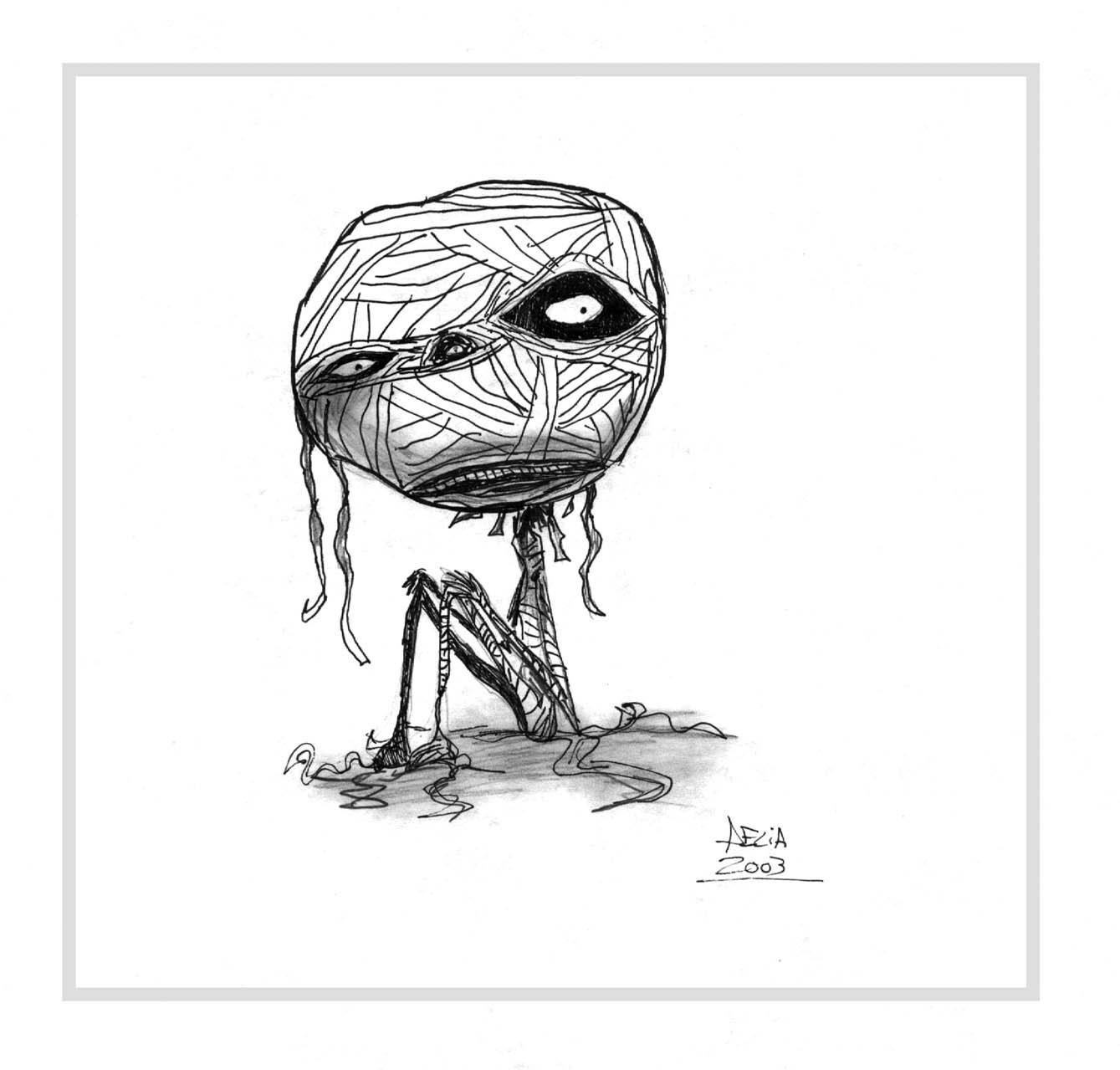
It is easy to see how Carl Jung and Sigmund Freud shared ideas about the collective unconscious. Although Jung's and Freud's ideas varied, Carl Jung's ideas of archetypes most closely resemble those ideas shown in Tim Burton's The Melancholy Death of Oyster Boy and Other Stories. Jung's archetypes of the shadow, trickster, and monster are all present within Burton's story entitled "Mummy Boy."
The shadow archetype is explained as the darker side of an individual's personality. Jung explains it as being worse the more a person or character suppress it. In "Mummy Boy," Burton illustrates the young boy chasing children around doing threatening things and letting out his dark side. In the end, they kill him because he was misunderstood. This illustration could be Burton's way of expressing how he felt angry at children when he was younger and wanted to take out his anger. On the other hand, it could mean that when Burton would let out his feelings and do things he considered fun, he would be shunned by the other children. This archetype is not the only one that appears in this story as the archetype of the trickster is also related to Mummy Boy's shenanigans.
When Mummy boy chases the children around and plays the game of "virgin sacrifice," he goes against the rules of how the normal children play. This unorthodox method of having fun and being malicious makes Mummy boy the archetype for the trickster. Again, it could be that Tim Burton used to have fun in unconventional ways that the other children did not understand or agree with when he was younger. Because of their misunderstandings, both Mummy boy and Tim Burton suffered consequences.
Mummy Boy's demise begins when his parents deem him a "pharaoh's curse" and ends when when the other children mistake him for a piƱata and kill him. Mummy Boy did not have the choice to be born the way he was. Yet his parents allowed him to wander around and seemed to not care about him or want anything to do with him. Both Mummy Boy's parents and children his age dehumanize him, thus making him the monster stereotype in their eyes.
In conclusion, Carl Jung's archetypes of the trickster, shadow and monster are all presented in Tim Burton's story "Mummy Boy." The shadow archetype is presented when Mummy Boy chases the children around with a knife. Although closely related to the shadow, the trickster is presented as well. Finally, the monster archetype is presented when the other children and Mummy Boy's parents ostracize him. The children finally destroy him, and no one seems to care. Through the whole story, Mummy Boy tries to be an individual through these archetypes, but the result is that society literally destroys him.
Burtons' increasing mental instability-Nick Arceneaux
(note, this picture looks like Alice Cooper but I assure you it is Tim Burton)
In further inspection of every story that Burton has ever written,
we can find several reoccurring themes such as abandonment, loss, or
isolationism. The way Burton interweaves these themes into is short poems
reflects the amount of time Burton has spent analyzing himself as well as
others. Many of the stories include characters that are hailed as worthless and
are unimportant. There are quite a few stories that include this theme so it is
quite possible that Burton often felt this way often as a child. He also writes
about a mermaid who fell in love with a musician and how they have a child but
it drags the mermaid down and eventually kills her. I think that Burton wrote
this story to reflect on the way he thought his parents thought of him. As if
he was the anchor but before being drowned they sent him away. I do not feel as
though Burton included many of Jung's archetypes. In his films, yes, in his
poetry, no. Burton indeed feels like he was abandoned as a child, and
coincidentally most of the characters in his book are children. I think that
each child in every story reflects the way Burton felt at a particular time in
his childhood. Jung’s archetypes, on the other hand, are used in many different
forms not unlike Burton’s stories. Burton uses the “neglected child” in his
poetry most often and it is apparent that Burton holds some grudge towards
those that abandoned him as a child. A topic he never really touches lightly is
the idea of the parent. Whenever he writes of parents in his stories they are
almost always malicious or evil in some way and I think that says a lot about
the kinds of feelings he has had. That isn’t to say that all of his work is
depressing. While Burton’s work may be dark and slightly macabre, he brings to
the surface the harsh reality of the world that we live in. His view of reality
is so harsh that he can seamlessly transition to fairytales about monsters and
then back to a normal world. But to Burton it isn’t normal. It isn’t normal
that the world is so harsh, it isn’t normal that there are abandoned children.
In his head he believes he was abandoned for a reason. Tim Burton believes that
he will never be loved and so to compensate he surrounds himself with people
who are deeply passionate about their work. Through passion he can relate to
those who have ever felt the same way and that is how he shows his love.
Through his movies and stories, rather than through his physical being.
Tuesday, October 1, 2013
Pilie- Edward Scissorhands
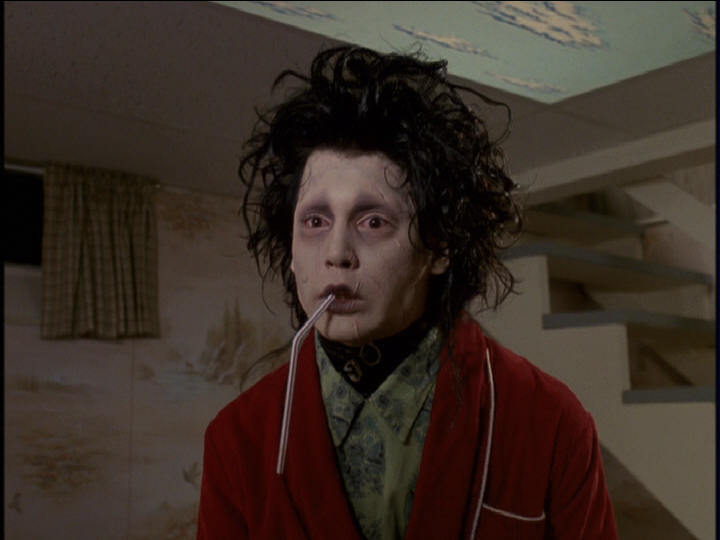
Like many other fairytales, this movie starts out telling a story. Winona Ryder is telling the story of Edward Scissorhands to her granddaughter. Unlike most fairytales though, this one has a bit of a dark side. This opening scene is what opens up the rest of the movie. Early in the movie, we find out how this neighborhood really is. All the neighbors of this town put on a fake "perfect" look. They want to be something that they're not. Their own issues and imperfections get in the way of this gossip-filled utopia that they have built for themselves. They don't want to accept that there is somebody who isn't just like them. Whenever Edward upsets them in any way, they want to get rid of him completely, like when they chased him into his house. The neighbors of the town never take the time to understand and appreciate how complex of an individual Edward really is. They see him as different and are intrigued, but when they can't get what they want, he must be banished. On the other hand, the love aspect in this film is a major aspect. Edward immediately falls for Winona Ryder. He wants her so bad, but he learns that she has a boyfriend. Throughout the movie, Edward has to deal with the pain of Winona having a boyfriend and the fact that he treats her badly. This conflict ends up turning violent when her boyfriend attacks Edward. Edward was set up to break into the boyfriend's house in an effort to try to get rid of Edward. At first, this didn't work, because Edward came right back home due to the fact that he was declared not normal. But, in the end it comes back to haunt Winona's boyfriend. When the mob chases Edward into the house on top of the hill, another conflict appears between the boyfriend and Edward. This ends tragic for the both of them. The boyfriend falls out of the window and is killed, while Edward and Winona are left upstairs in the house. She wants to kiss Edward, but he cannot do it. This ends up haunting Winona for the rest of her life, but at the same time is somewhat comforting to her. She fell for Edward, but couldn't have him. Even though this is the case, she is content with the fact that Edward is still alive and around, because she knows the world really is a better place with him.
Subscribe to:
Posts (Atom)


.jpeg)