Showing posts with label Melissa Johnston. Show all posts

Friday, December 6, 2013

Johnston - Final Blog

When I signed up for this course, I simply thought that it would be a fun class where we would watch Tim Burton films, but The World of Tim Burton has truly opened my eyes and allowed me to look at and analyze movies in a way that I never had before. This course has showed me that there is an incredible amount of effort that goes into creating a film and that each and every scene has a connection in one way or another to the deeper meaning embedded in the film. 
       Tim Burton is by far my favorite director and I have watched these movies countless times, but before this class I would have just sat and watched the movies and would not have fully appreciated the meaning that was incorporated within each film. I wouldn’t have noticed things such as the meaning behind the colors of each scene, the uniformity of suburbia, the outcast, or the meaning of the “house on the hill” without having taken this course. From this class, I have been able to understand things such as why the director places a character in a certain spot in the frame, why he fills the frame with the colors he does, and the importance of the lighting in each scene. Before this class, I would not have been able to appreciate how all these elements come together to relay the meaning within the film. 
       When I watched these Tim Burton films before taking this class, I never saw how films reflected the director’s life experiences and feelings. For example, in Big Fish, William and Edward’s tumultuous relationship truly reflects Burton’s relationship with his own father, or how the band of misfits in the circus come together to make a family just as Burton did with the actors and people that he uses to create his films. Throughout his life, Tim Burton felt as though others misunderstood him and Burton’s films always have a character that simply wants to be understood, which is something that I would not have noticed before taking this class. 
       Dr. McCay, thank you so much for an amazing semester! This course was by far my favorite courses I have ever taken and I am truly sad that I will not have this class next semester. I hope that I get the privilege of taking another class from you in the future!

Sunday, November 24, 2013

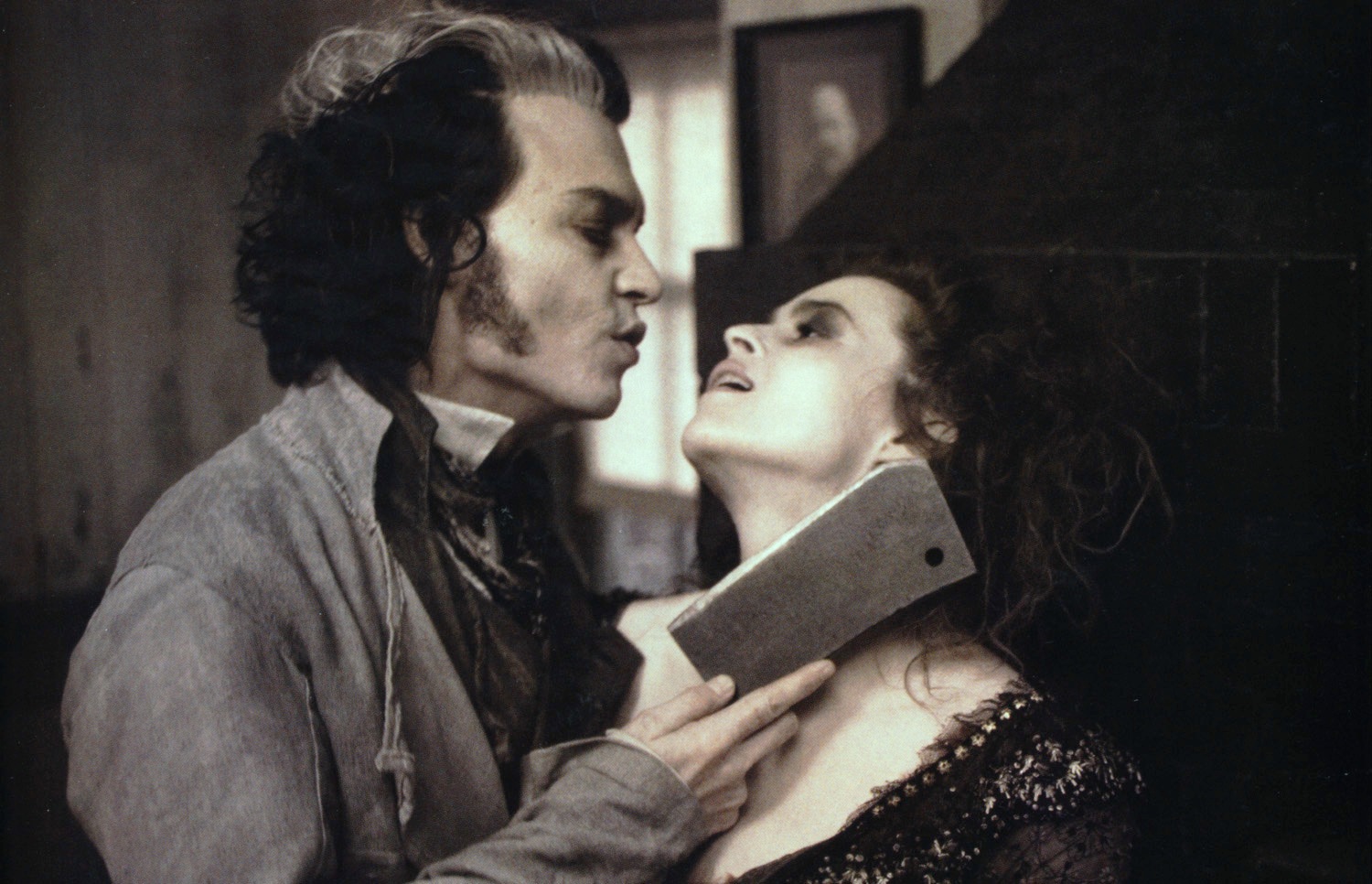
Johnston - Sweeney Todd

     Before Sweeney Todd came to be the man we see him as in the film, he was Benjamin Barker, a barber on Fleet Street with a wife and young child. Judge Turpin sent Barker away on false charges and Barker has now returned to take revenge on the Judge, using the false identity of Sweeney Todd to hide who he really is.
     In the beginning, his only goal was to kill Judge Turpin. A street barber, Adolfo Pirelli recognizes Sweeney as being Benjamin Barker when Sweeney challenges him to a shaving contest. Pirelli later comes to Sweeney's barber shop above Mrs. Lovett's pie shop and threatens to reveal who Sweeney Todd really is, so Todd kills him. It is at this moment when Todd's goal changes from killing only Judge Turpin into killing all the powerful people in London. When Mrs. Lovett discovers that Sweeney killed Pirelli she gives him the idea that they could use him as meat in Mrs. Lovett's meat pies.
     In the song "A Little Priest" Todd and Lovett sing about all the people they could use in their meat pies, such as a priest or a royal marine. These people are all of high social and political power in London, so by eating them it will truly be, as the song says, "those up above serving those down below." They also say that they would not want the poet in one of their pies. This is because the poet has no power in London. This relates to the social and economic status of England at the time. Rural areas were being "devoured" by the large, expanding cities. People living in these rural areas were plucked out of their countryside homes and planted into the city. In this sense, it was "man devouring man." There was no more care for the individual. The focus was now put on the urbanization and expansion of cities and those who were not able to keep up were chewed up and spit up. There is also the sense of "you are what you eat" because Sweeney Todd becomes just like one of the people he has killed because he is murdered in the same way by his own razor. This film includes both literal cannibalism, by using the victims of Sweeney Todd in Mrs. Lovett's meat pies, and metaphorical cannibalism, by the powerful people and the urbanization in London devouring the rural areas and the people with in them.

Sunday, November 17, 2013

Johnston - Big Fish

     Tim Burton's Big Fish incorporates a theme that we have seen in many of his other works – a group of misfits creating a family. The happy, brightly shining character of Edward Bloom befriends many characters in the film that do not have as sunny of a personality as Edward. Even from the beginning of the film we can see that Edward is not afraid to accept people who are different than he is. When he and his friends go to the witch's house in the middle of the night Edward simply walks up to the door and when she answers he asks very politely "Ma'am, my name is Edward Bloom, and there some folks that would like to see your eye". Instead of being afraid like the other children, Edward treats the witch like he would any other person.
     Another example that shows Edward accepting someone who is seen to be darker and more monstrous than he is, is the scene with the giant. Instead of joining the angry mob that wants to run the giant, Carl, out of town, Edward takes the time to talk to Carl and learn why he is doing what he is doing. He learns that Carl is not eating all the townspeople's sheep because he is evil, like the townspeople think he is, rather, he is doing it simply because he is hungry. Just because Carl is different than him, Edward still accepts him.
     The next time Edward accepts a character that has a darker side to them is when the Amos Calloway, the circus ringleader, turned into a wolf at night and attacked Edward. Instead of running or trying to kill Amos, like the clown with the gun tried to do, Edward simply picks up a stick and begins to play fetch with the animal. He realized that just because something seems dark and monstrous doesn't necessarily mean that it is, saying "it was that night I discovered that most things you consider evil or wicked are simply lonely, and lacking in social niceties".
     Burton uses the character of Edward to make a statement about how our society treats people who are different. We always say "never judge a book by it's cover", but do we always end up using it in practice? Burton is trying to say that we should take the time to try and understand things that are different from us instead of just judging before we even know a person because many times are assumptions are very different than reality. 
     

Sunday, November 10, 2013

Planet of the Apes - Johnston

In Tim Burton’s Planet of the Apes, there is a strong sense of duality between the idea of civil liberties versus the idea of slavery. In the beginning of the film we see Captain Davidson, part of the US Airforce, attempting to train a monkey, Pericles, to venture out into space on his own using a virtual reality program. Later in this scene we see a row of cages with a monkey in each. Captain Davidson’s monkey was sent out to collect data on an electrical storm in space when the monkey was lost. Captain Davidson went out to try to find Pericles and was sucked in by the electrical storm and catapulted into a completely new world. This world is one where the apes are the rulers and the humans are the ones in cages. Davison traveled from a world where humans were the ones with civil liberties and the monkeys could be considered the slaves, into a world that was exactly the opposite.
       On this new planet, humans are practically hunted and captured, and eventually sold to an ape. Unlike what Captain Davidson was accustomed to, on this planet the humans were the slaves and catered to their ape ruler’s every wish. Captain Davidson asks the question of how this planets ideals became so backwards, but to the apes the idea that apes are masters and humans are slaves is not backwards at all. Not every ape believed that the humans should be treated as slaves though. There was one ape, Ari, who believed that the humans were not deserving of the awful treatment that the apes put them through and tried to help Captain Davidson and some of the other humans escape from the ape.
       When watching this movie I found myself asking one big question. Do we feel bad for the humans because we believe that it is wrong to enslave another creature, or simply because it was humans who were the ones being enslaved? The answer to this question may seem obvious to some, but when I watched the movie I realized that when I saw the monkeys in cages I didn’t necessarily feel bad per say. That’s not to say that I think putting animals in cages is right by any means, I love animals, but every day animals like mice and rats are put in cages and used for experiments to further science and many people don’t consider that as enslavement. It wasn’t until I saw the humans being used as experiments in the 1968 version of Planet of the Apes that I made the connection between animals that could be considered enslaved every day, in zoos, for example. In the 1968 version of the film, the nephew of Dr. Zira, Lucius, asks Dr. Zaius “why must knowledge stand still? What about the future?” just before Dr. Zaius was about to blow up the caves that proved that apes evolved from humans. Planet of the Apes shows us that instead of enslaving or committing harmful acts against our own kind we should use each other to further the world around us, and realize that it is only by chance that we are considered the rulers and we could have just easily have been the ruled.

Sunday, November 3, 2013

Johnston - Sleepy Hollow

     Although Burton incorporates Although Burton film Sleepy Hollow contains many of the same ideas and elements found in Washington Irving’s The Legend of Sleepy Hollow, there are still many differences seen between these two works. The first obvious difference is with the character of Ichabod Crane. In the film, the role is played by none other than Johnny Depp, a tall and good-looking man, but in the story the readers are led to believe that Ichabod Crane is awkward and unattractive. The physical appearance of these portrayals of Ichabod Crane is not the only differences concerning this character. In Irving’s story, Ichabod Crane is a schoolteacher, whereas in the film, he is a constable. In the story, Ichabod Crane is an overtly superstitious, but in the film, Ichabod Crane tries to hide the fact that he is superstitious.
     Another difference between Irving’s at Burton’s works is the ending. In the story, Ichabod Crane flees the town when Brom throws a Jack-O-Lantern at Crane while he is dressed as the headless horseman. In the movie however, Ichabod does not flee because he hears Brom and his friends off in the distance laughing about what just happened.
     Burton also creates more depth in the character of Ichabod Crane by giving insight to why he is the way he is. Burton includes scenes that show some of Ichabod’s dreams, and even tells us that Crane’s mother was murdered by his father because his father believed that Crane’s mother participated in witchcraft.
     Another difference is the relationship between Ichabod Crane and Katrina Van Tassel. In Washington Irving’s story, Ichabod falls in love with Katrina, but the same feelings are not reciprocated. In Burton’s film Katrina falls in love with Ichabod, even going so far as to try to cast a spell on him in order to protect him from evil things.
     In comparing both the story, The Legend of Sleepy Hollow and the film Sleepy Hollow, I think Burton uses Washington Irving’s idea, but elaborates on the story, and creates the story of what would have happened if Ichabod did not flee after Brom’s cruel joke. I think Burton added more depth into Irving’s characters, and created the original story to produce a story of his own.

Sunday, October 27, 2013

Johnston - Mars Attacks!

In his film, Mars Attacks!, Tim Burton includes many stereotypical ideas about the American government. For example, in one of the beginning scenes the president, played by Jack Nicholson, is told about the possibility of an alien invasion. Instead of even remotely thinking about the situation presented to him, he instead turns as asks his press secretary what he thinks about the situation. This action portrays the stereotypical idea that the most important concern for the president is not the possibility of his people being in danger, but instead how this danger will affect his image as a leader. It also portrays the idea that the president is simply a figurehead or a puppet that cannot form his own opinions and simply does what others tell him to do.
Another stereotype of the government that is seen in the film is the scene where the aliens are attacking the White House. The president and his family are running around the White House trying to find a place safe from the aliens, and instead of going the fastest way, they take a roundabout way to the safe place simply because there is a tour in their path. Even with the eminent danger of the alien invasion just minutes away, the tour group is still unaware of the danger that they are in, and the tour progresses as it would normally. This portrays the stereotypical idea that the government does not tell the people everything, even if they are in danger.
Burton also pokes fun at the American government in the scenes where the boy and his grandmother are riding around playing “Indian Love Song,” which is killing all the aliens. We see a tank-like vehicle with American soldiers walking next to it acting like they are there to help, but really all the soldiers are doing is poking at already dead aliens. This scene is commenting on the fact that the government cannot actually accomplish anything without the help of the people.
Burton not only satirizes the idea of the stereotypical American government, but also the idea of the educational elite. Professor Donald Kessler is a tweed-wearing, pipe-smoking, pompous professor who believes that simply because he has his Ph.D that he is all-knowing. We see that he is, in fact, just as ignorant and naïve as all the others when he assumes that just because the aliens are advanced life-forms that they are peaceful creatures. What he does not care to take into consideration is that humans are considered to be advanced life-forms, but yet there is constant violence and warfare on our planet.

Friday, October 18, 2013

Johnston - Ed Wood


     Ed Wood was a B-movie director who was ultimately deemed the “Worst Director of All Time” in the book The Golden Turkey Awards. One of the ironic things about Tim Burton’s film Ed Wood is that this movie is about one of the worst directors the world has ever known and it also turns out to be known as one of Burton’s worst movies of all time.
     Even from the beginning of his film Ed Wood, Tim Burton is paying homage to world's worst director. The beginning credits are very similar to those in Ed Wood's actual film Plan 9 with the man in the beginning talking about the horrible story that the viewers are about to see, to the grave stones and the extremely cheap looking UFOs.
     Burton can relate to Ed Wood as a director because they were both told many times by producers that what they were creating was not going to intrigue audiences, which would mean that these films would ultimately be unsellable. Both directors were/are extremely passionate about their works no matter how many times they were shut down by the film industry. Burton admires Ed Wood’s passion and how he stands behind his works even if other people don’t think that they are of quality. Even with minimal to no monetary funding, Ed Wood’s passion and love for his works is evident in his films.
     Another way Tim Burton and Ed Wood relate as directors is that they both created films that have very personal themes. Ed Wood enjoyed cross-dressing in his spare time and decided to create his film Glen or Glenda, which was almost a direct parallel to his life. In Ed Wood, Burton really displays how comfortable cross-dressing makes Ed feel, but at the same time he shows the struggles Wood’s relationship goes through because of this secret. Burton’s film many times have themes about isolation or characters that have been isolated because they are different from other people, which is similar to how Burton felt for the majority of his life.
     Similarly to Burton, Ed Wood created a family with the band of misfits he used to create his films. As Christina said in class, outcasts in a group no longer are outcasts because they have found others that are similar to themselves. This is what similar to what Tim Burton did and still does in his own life. When he was a child, Burton felt like an outcast in his own family, but through his films he has created the family he has always wanted.

Friday, October 4, 2013

Johnston - Brie Boy


In the poem "Brie Boy", Brie Boy is a young child with a round of brie cheese for a head. None of the other children allowed Brie Boy to play with them because he is so different. At the same time, in the last line of the poem it says “but at least he went well with a nice chardonnay.” I think through this poem Tim Burton is trying to make the statement that society can either choose to reject something or someone that is seen as strange and unusual or it can choose to accept this difference. I also think that he is trying to make the statement about societies tendencies towards the artist. Many times an artist is rejected because they may create things that are out of the norm, like how Disney rejected Tim Burton’s drawings because they were not the normal happy, cheerful Disney drawings everyone was used to. On the contrary, society also has a tendency to use artists because of how different they seem. The example of this in “Brie Boy” is that at first everyone rejected him because of his differences, but over time they will all want a piece of him because he goes so well with “a nice chardonnay”. These contrasting sides of society can relate to Burton’s own life. When Tim Burton was young he was considered the black sheep of his family and was eventually shipped off to his grandparent’s house. When he was at Disney, his drawings weren’t used because they were too different. Now, Tim Burton is one of the most well known movie directors and thousands of people are vying for a chance to work with him. Think about how many people could have possibly tried to use Tim Burton’s success in order to build up his or her own success. I think the possibility of people using Tim Burton’s talent and status in the film industry in order to further their career is one of the reasons why Burton is very careful and meticulous in the choosing of whom he associates himself with, from his film crew to his actors.  As far as Carl Jung’s archetypes, I think that Brie Boy is the monster archetype, not because he is evil, but because many times in Tim Burton’s work the monster is someone who is different and misunderstood. In Gothic Fantasy, it emphasizes how Burton more closely relates to the monsters or villains in is stories or films because they are the characters in his works that are misunderstood or damaged as a result of isolation and hatred because they are different than others. I also believe that Brie Boy is the manifestation of Tim Burton’s feelings about isolation and about how alone and different he felt for most of his life, but also how he realizes that many times society goes through trends of hating something that is different or strange, to using the unusual qualities of this person or thing for their own personal gain.

Saturday, September 28, 2013

Johnston - Edward Scissorhands


Green lawns, brightly colored houses, blue skies. The perfect disguise for the not so perfect neighborhood. When we first meet Edward we see him as a misunderstood creation, separated from society. We look at him sort of as a child, naïve and unaware of the hatred the world has to offer. Edward and the neighborhood are exactly the opposite. From his clothing one could make the assumption that Edward is a dark and gloomy person, but on the inside he is kind and full of nothing but good intention. The neighborhood on the other hand seems like the ideal neighborhood, but all that lies with in is people full of judgment and hatred. In the beginning it seems as though Peg is rescuing the damsel, or in this case the gentleman, in distress. She seems to have saved Edward from his life of isolation and misery. She brings Edward into her home and before we know it the neighborhood loves him. He is creating art out of peoples shrubbery, pets, and even their own hair. It seems as though Edward’s happily ever after is finally coming true. But what really happens after the happily ever after? Is that really the end or is there more to the story that we aren’t told? Does Snow White’s forest burn down? Does Cinderella’s Prince Charming leave her? 
http://www.fallenprincesses.com
For Edward his “after happily ever after” is filled with animosity and misunderstanding. How did Edward turn from the naïve, child-like character into the character that the people of the neighborhood want dead? Society. Society has taken Edward, someone who has the kindest heart in the world and has turned him into a monster, or at least that’s what the people of the neighborhood start to see him as. Jim uses Edward in order to steal from his own father, but in the end Edward is the one who takes the fall for the crime. Like in the story Frankenstein, Edward is not a monster he is simply misunderstood. For instance, when Edward saves Kevin from being killed by Jim and his drunk-driving friend. Instead of realizing that Edward has prevented any harm that would have been done to Kevin, the people of the neighborhood think that Edward is attacking Kevin and begin to attack Edward. In the end of the movie, the mob of people from the neighborhood chases Edward back to his mansion. This can be interpreted as society chasing away or destroying everything that is pure and wholesome. So, in the end, did Peg really save Edward? 

Friday, September 20, 2013

Johnston - Catwoman & Batman


       Scene: Bruce Wayne sitting at a conference table across from Max Shreck, the business mogul of Gotham. In walks the newly sultry, Selina Kyle. She instantaneously catches the attention of Mr. Wayne, in the sort of “love at first sight” typical romantic movie way. To Bruce, Selina seems like the kind of woman he would enjoy taking home, the new Vicky Vale. What he doesn’t know is that she is no Vicky Vale and that his life is about to become much, much more complicated. What Bruce also doesn’t know is that this isn’t his first encounter with the lovely Ms. Kyle. During the ceremonial lighting of the Christmas tree, the cult of crazed clowns descends on Gotham, leaving destruction in their path. One of the members tries to attack the “pre-attempted-murder” version of Selina just as Batman arrives. Of course, Batman saves the damsel in distress and they both continue on with their merry lives. Wrong. This is only the beginning of their multifarious relationship.
       The next time they meet is at Batman and Catwoman, just as Catwoman blows up Shreck’s office. Batman seems intrigued with Catwoman, just as Bruce was with Selina. He follows her up to the roof of a building where they commence their first fight. At first Batman doesn’t fight back and seems to be perplexed by Catwoman. It isn’t until she almost pushes him of the edge of the building that he begins to retaliate. Even then, he stops when she asks him how he could possibly hit a woman. He walks over to her thinking she is actually hurt, this makes him vulnerable, which Catwoman uses to her advantage as she proceeds to kick him in the stomach. The fight continues until Batman has Catwoman dangling over the edge. He pulls her up and she starts to use her womanly charm to trick Batman into thinking that she is thanking him for saving her. That is, until she digs her claws into his side. Batman shoves her of the side of the building where she lands in a dump truck filled with kitty litter. Thus, begins the hate-hate relationship between Batman and Catwoman.
       The next time the pair is seen together as Selina and Bruce is at Bruce’s house. This relationship is a stark contrast to the Batman and Catwoman one. Unlike in the Batman and Catwoman relationship, the two have genuine desire for the other. The scene starts out as the normal first date until both decide to cut it short when the other almost reveals their wounds from the fight as Batman and Catwoman. As the desire between Selina and Bruce strengthens, so does the hatred between Catwoman and Batman. The relationship becomes most complex when the two find out who the other truly is. They don’t know whether to follow the path of the Selina-Bruce relationship or the path of the Catwoman-Batman relationship. Throughout the film Selina makes Bruce vulnerable, which is ultimately destructive. From their first encounter as Batman and Catwoman, to their last interaction when Bruce decides to take of his mask in attempt to save Selina.

Friday, September 13, 2013

Johnston - Batman and the Trickster


     The trickster is a person who is always trying to escape the “prison” that society has put him in. When the term “prison” is used, it is not referring to a physical building, but instead it is signifying how the trickster is put in isolation from the rest of society. The trickster is frequently someone in the society who is seen as an outcast.
     In Tim Burton’s film, Batman, the Joker is the trickster character. He is isolated from the rest of society because of his appearance. The one scene where it seems that the Joker is starting to escape his prison is the parade scene. It is the one part in the movie where the Joker is accepted into society instead of being on the edge.
     In the film, the Joker infects many cosmetics, so that when people of Gotham use these products their face will start to look like his, and eventually they will die. Some may argue that by doing this, the Joker is going against the idea of a trickster, and that he is actually NOT trying to escape the prison society has put him in, and instead is simply making his prison bigger. I think that by making people like him, he IS trying to escape his prison. The “prison” is isolation put on the outcast of society, so by making everyone just like him, the Joker is no longer an outcaste, and therefore has succeeded in escaping his prison.
     In this film, Burton is also questioning who the real tricksters in society are. The government of Gotham is extremely corrupt. To the public, they seem to not know what is going on, but behind the scenes, they are the cause of all the chaos in the society. When the Joker transforms into his “post-acid accident” self of Jack Napier by wearing his makeup, he represents the wealthy members of society. When he takes of his makeup, he reveals the true side of the upper class of Gotham, who are the true tricksters.
     Another aspect of a trickster is that he is able to manipulate people. The Joker is very good at manipulating the general public. He uses his makeup as a mask in order to make the people of Gotham believe that he is just like them. By having the Joker wearing a mask of makeup that makes him seem to be an ordinary person, but underneath is really the uncivilized, animalistic Joker, I think that Burton is asking the question of whether or not we are truly civilized, or if it is simply a mask we wear.

Thursday, September 5, 2013

Johnston - Beetlejuice


Americans love control. One of the reasons we as a culture fear death because it is something that we cannot control. Americans tend to forget, whether purposefully or not, that death is inevitable. In the film, Beetlejuice, Burton turns the thought of death from something that people dread to something that they laugh at. For instance, in the scene with the waiting room. The waiting room in Beetlejuice is eerily similar to the ones that we wait countless hours in every year, but instead of being filled with sick people, this waiting room is filled with people who are dead. From a shark attack victim, to a magician's assistant who's trick obviously went wrong, to a man who seems to have choked on a bone. Burton does not accept the reality of death, instead he turns it into something that people can relate to.

Another way Burton rejects the idea of death is with the Maitlands. Typically in movies, death is seen as the end, but for the Maitlands, it is just the beginning. Throughout the film they continue to interact with Lydia as if they were alive. In the end of the story, Lydia comes home after school and Adam and Barbara ask her questions about her day and about her grades like any parent would. From this scene you get the feeling that the Maitlands are living somewhat of a "normal" life even though a girl discussing her daily events with dead people is anything but normal.

Death is seen as an anathema by our culture because we do not want to believe that everything that we do in life is for nothing. Take for instance someone who is a surgeon. Their parents spent thousands of dollars every year for them to attend college and eventually medical school. They will spend anywhere between 8 to 15 years in school in order to work in this profession. Then once they have a job as a surgeon they will spend 50-60 hours working in a hospital leaving minimal time for family. If they choose to have kids, they will spend thousands of dollars on their children's education just like their own parents did. The reason the American culture vehemently dislikes the thought of death is because we don't want to believe that we spend the majority of our lives either going to school or working just to have none of it matter once we die.

Thursday, August 29, 2013

Johnston - Introduction

When I first walked into my dorm room I thought, 'Wow, this room is much smaller than my room at home, and I'm going to have to share it with another human being. Are my roommate and I going to get along? How was I going to share a bathroom with 40 other girls?' I'll admit, I was a little hesitant coming in. Coming from North Carolina, out in the country, I experienced slight culture shock when I first arrived. The city of New Orleans is unlike any other that I have been to. In New Orleans, there are always people moving, always music playing, never a dull moment. The first night my roommate and I, and some of our hall mates, decided to take a walk to uptown. On our way back we decided to stop at the infamous Taco Truck. I was a little skeptical at first, I mean, when I was little my parents taught me never to take food from people in a van. After the first bite though, I was thoroughly surprised. Taco Truck: A+.
Now that classes have started, I have realized how useful good time management skills are. After the first day of classes I already had three assignments, including two papers. As much as I want to go out and explore the city every night, I know that in order to have the grades that I want I will need to prioritize. In high school, I had every class almost every day, and here I only have a certain class every other day or even only once a week. This spacing of classes allows me finish an assignment more thoroughly than I would if I had the class every single day. Everyone says that college is the best time of your life, and I'm excited to immerse myself into everything that Loyola has to offer. In the few short days that I have been at Loyola, I have learned many new things about myself and about the world around me. I’ve learned that there is more to the world that the small town I grew up in. I've learned that in order to succeed that I need to be able to manage my time in a way that maximizes my success and minimizes my stress. Most of all, I have learned to go into every experience with an open mind, even if it is a taco from a van.