Friday, December 6, 2013

Wadsworth- The World of Tim Burton


The World of Tim Burton; this class has opened up my eyes to film and the way it works. Before when I watched movies I never saw anything behind it, just the plot of the movie. I would have never thought about who directed it or why certain people played certain roles; these characteristics in films make the difference and I would have never thought about this before this class. I learned so many things about film in this class that I probably would have gone my whole life without knowing. When I watch a movie now I feel that I looked at it differently than before. I feel that I get more into my movies.
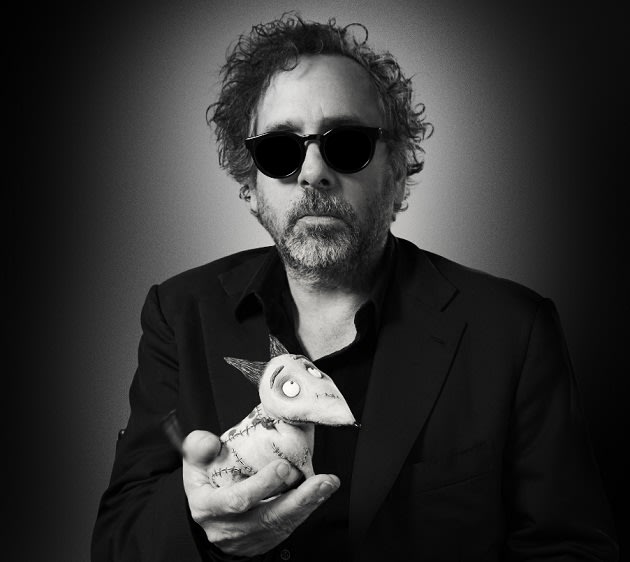
I have opened up my eyes to the strange and unusual side of film. I have always been a fan of some of his movies, but from this class I have accustomed a new favorite movie of mine, Big Fish. Big Fish has so much meaning behind the movie. It brings tears to my eyes to watch it. I think I love this movie even more so because I know why Tim Burton made this film. As we all know he likes to put himself into his movies, but for this movie I feel was more intimate for Burton. This was a little of his past and a little of his future. For these reasons my photos I choose for this blog is Burton in his natural habitat, directing one of my favorite movies.
In the top left corner, we see Burton and his significant other. You look at this photo and see emotions in their face and the concern. This is a real life emotion for them. There was no acting going on here and that is what makes these photos my favorite photos of Burton. All these photos you see Burton with his emotions and his directing. You see him doing what he does best. I could not pick just one, I picked these four because each one is a little different but i favor them all equally.
Coming into this class I would have never expected to come out knowing what I know. Dr McCay is an amazing professor and she knows how to take learning to a whole other level. Not only did I feel that I was in class, I felt enjoyment going to class. This by far is my favorite class of the semester and I wouldn't doubt if this is my favorite class all throughout college. The funny thing about this class and it being my favorite is that English is my most hated subject. This class made me want to write and show my opinion on the things we watched and talked about. Before if someone told me I had to write a 500 word blog I would dread the idea of it, but for this class I was rather excited to write this blog I am composing now. I feel like writing isn't as bad as I always thought it was. So to sum this up, I will say that this class has opened my eyes to a whole new world of film and writing.

Esteva - Reflective Blog


   Through the development of this course we have watched a total of eleven movies and read one book of the publicly acclaimed director, writer and cartoonist Tim Burton. Since the course started we have studied the different elements and aspects that characterize the various films and how to analyze them.
     Within the aspects of a film that we learned how to analyze is the story line and how each movie is divided by and introduction, the moment of climax or the conflict and the resolution to said conflict. Knowing this helps one realize what are the truly important points of every movie and what the director wants you to give more attention to.
     Another thing that we practiced a lot though the course was the use of mise en scene. This term, in movies, refers to how all the visual elements of stage production are placed. Practicing the analyze of the elements in frames of the different Tim Burton movies has made me understand more clearly why directors do what they do while filming the movie. For instance, if the choose to portray any character with the camera looking up at him or her, is because they intend to give said subject certain power or sense of greatness. Because of mise en scene I am now able to understand more clearly what the director is trying to say to the audience.
     Between what was studied in the course we also had what is known as biographical criticism, or the links between certain way of art and his or her creator. In most of the Tim Burton films watched during class this is a very present aspect. As we learned through our book, Gothic Fantasy, Tim Burton went through a rough childhood. His family and friends never accepted him, so most of the time he was obligated to be by himself and feel like a total outcast. As we have seen in his movies many of the main characters have the same characteristics he had as a child. For example, since a young age Bruce Wayne was alone an misunderstood, which led him to find something he could do to entertain himself, so he created Batman. Tim Burton also as a lonely person found refugee in his art. His way of escaping reality was his drawings, writing and later in life his movies.
     Edward Scissorhands also represents how Tim Burton felt during a long period of time. Alone, even though at some point he had many people surrounding him. These two mentioned characters are also an example of an artist’s expression. For Tim Burton, he created someone he could relate to and feel close to.
    During this course I also realized something that every person should know. Even though you already decided what you want to be in life and already know what you have to do in order to achieve it, it is also important to go slightly out of your path and stop to learn about different things. Because, although it may not benefit you in your goal but it will certainly change the way of how you see life and what life gives you. 

Johnston - Final Blog

When I signed up for this course, I simply thought that it would be a fun class where we would watch Tim Burton films, but The World of Tim Burton has truly opened my eyes and allowed me to look at and analyze movies in a way that I never had before. This course has showed me that there is an incredible amount of effort that goes into creating a film and that each and every scene has a connection in one way or another to the deeper meaning embedded in the film. 
       Tim Burton is by far my favorite director and I have watched these movies countless times, but before this class I would have just sat and watched the movies and would not have fully appreciated the meaning that was incorporated within each film. I wouldn’t have noticed things such as the meaning behind the colors of each scene, the uniformity of suburbia, the outcast, or the meaning of the “house on the hill” without having taken this course. From this class, I have been able to understand things such as why the director places a character in a certain spot in the frame, why he fills the frame with the colors he does, and the importance of the lighting in each scene. Before this class, I would not have been able to appreciate how all these elements come together to relay the meaning within the film. 
       When I watched these Tim Burton films before taking this class, I never saw how films reflected the director’s life experiences and feelings. For example, in Big Fish, William and Edward’s tumultuous relationship truly reflects Burton’s relationship with his own father, or how the band of misfits in the circus come together to make a family just as Burton did with the actors and people that he uses to create his films. Throughout his life, Tim Burton felt as though others misunderstood him and Burton’s films always have a character that simply wants to be understood, which is something that I would not have noticed before taking this class. 
       Dr. McCay, thank you so much for an amazing semester! This course was by far my favorite courses I have ever taken and I am truly sad that I will not have this class next semester. I hope that I get the privilege of taking another class from you in the future!

Young - Reflective Blog


At the beginning of the year, I would have never guessed what the Tim Burton Seminar entailed (other than what I could guess from reading the syllabus of course). I guess I thought it would be something along the lines of just watching the movie and lightly analyzing Burton's style. Instead, reading Gothic Fantasy, the articles from Blackboard, and participating in class discussions has allowed me to gain so much more.

The underlying theme that runs in all of Burton's movies, which are usually isolation and abandonment, all relate back to Burton's childhood as well as his young adult years working at Disney. I would not have known to look for autobiographical information within his movies if I did not at first know some background on his life. Like the father in Big Fish, Burton tells his stories with fantasy, exaggerations, and eccentric characters all to express himself through his art. The biographical information and class discussions not only helped to analyze the plot within his movies, but they also aided in the mise en scene analyses.

Every time I look at a movie, I can't help but notice now what the director is trying to do. I have noticed that other directors use mise en scene, or some form of scene composition, to create each frame as though it were a work of art. They interweave symbolism as well as visual clues as to how the scene should be interpreted. I believe Tim Burton does a fabulous job of making each scene look artistic and aesthetically pleasing while simultaneously making the scenes mildly conspicuous compared to all the others.

Finally, by analyzing Tim Burton's films, I have gained valuable writing skills that are not completely formulaic. It is refreshing for me to think about a different kind of writing style because analyzing movies does not follow the typical essay format, which was a relief. The movie review forced me to think outside of the box a bit relative to how the typical essay usually sounds. The research behind the paper was not very tedious because for me it was considerably enjoyable.

As for the rest:

College has been stressful. I have yet to see the reward in it, but I know it's just a long waiting process filled with work. This view may seem overtly negative, but that's just how this semester has gone. I've honestly felt more alone this semester than I have in a while but that's also because I'm away from home and friends etc. The fact that everyone else here pretty much feels the same way too, whether or not they verbalize it, does make me fell a little better.

I'm really enjoying my time here at Loyola and especially New Orleans. It's a city where you can't see everything there is to see even if you live here your whole life, and I've just arrived. The concept is exciting and intimidating but we all fell like little fish in a big pond. By the end of the next four years, I'm sure we'll feel as claustrophobic as ever, and we'll be ready to leave. But for now, no one should stress too much. We're just getting into the swing of things.


Nick Arceneaux-The World of Tim Burton

The World of Time Burton was a course that taught me many things about Tim Burton the man, Tim Burton the poet, and Tim Burton the storyteller. In life any good quality comes from experience. The fact that Tim Burton does what he does so well only adheres to the fact that he has been through what most people would call an interesting life. I find inspiration in reading Gothic Fantasy because I know that Burton had a dream and he chased it and it became reality. What have I really learned through this course though? I view this course less of a rigorous class and more of a reflective class because Burton shares the same feelings and emotions on screen that we feel inside ourselves. The true magic of watching one of his movies is being able to relate to the character on screen even though it may be in a fairytale. I like to think of human emotions being subconsciously ingrained into the human psyche for millennia. We share the same fears, beliefs, and morals that our ancestors had. How clever is it to pick up on that knowledge and to use it to your advantage. But I don't ever think that it was Burton's plan to get famous or rich. I think Burton just wanted to live a happy life while pursuing a career in animation. Of course genius will never go unnoticed though. For a man with such a childhood as his I would have expected less to come of his life but I think that is the beauty of it all. That is what makes him so inspirational is that he came from relatively nothing except his talent and imagination and he made something out of a bland and boring life. I think in that sense Burton really lives out the saying "there is beauty in the dark." His life can also show what a killer suburban life is to the malleable minds of children. It's like being put in a gray corner, neither here nor there. In between the city and the country, in between both extremes, the black and the white. Suburbia is limbo for creativity. One can go as far as to say suburbia kills creativity, and it does. Burton beat the odds though, he made it out of suburbia alive and still has some (albeit some) of his sanity left. He is the hero of a generation of emotionally charged teenagers and abandoned rejects alike. He is the Jesus of suburbia (stole that line from Green Day.) Seriously though, he is a little bit of a savior for the kids who have horrible lives. Burton can make you laugh, he can make you wince, he can even make you cry. But why does anything make you feel a certain way? It is because you can relate to that creature on the screen. If you can relate your audience to a character on a screen then you are giving the viewer a peephole into your mind. And if Burton's films are any indication of what his mind is like, then he must be living in beautiful insanity. 

Thursday, December 5, 2013

Feltes- Final Reflective Blog


        Over this course, I learned many things about movie watching that will help me in the future to better analyze film. First of all, the concept of mise-en-scene was entirely new to me, and I learned just how important it is and how much Burton incorporates it into his movies. To be honest, I had already assumed that the brightest or most clear image in a still frame of a scene was the focus of the scene, or the dominant, but I was incredibly interested to learn about how the second things that attracts your eye is the subsidiary contrast. This really opened my eyes to how much work is put into the filming of movies.  I also learned that if you learn to look for the dominant and subsidiary contrast’s while you are watching a movie, you can more easily find the focus of the scene and the emotion that the director is trying to convey with each scene, which is important because occasionally, the mood is not what you would assume and you can even catch forewarning’s of things to come. I also learned that Burton is not only a movie director, but he also writes pretty creepy poems. I learned much about Burton’s past, which was also interesting, and this helped explain Burton’s skewed view of relationships between kids and their parents, and his view of parents and parenting in general. One thing that I did not learn throughout this course was the reason for Burton’s incredible obsession with Johnny Depp and why he loves him so much.
       During this course, I also learned that I personally have a tendency to put off my work an incredible amount and I actually worked a lot over this semester to improve this bad habit. I learned that if properly motivated, I have the ability to complete a 1500 word draft of an essay in one night, and not do a half bad job of it either. I learned that Burton directed more than one Batman movie, which was really awesome to learn because I loved how well Michael Keaton acted in the original, and it was incredibly cool to see another movie with him as the star. I learned that while all of Burton’s movies differ in their themes and message, they all have similar themes that relate to Burton himself and more specifically his own childhood. Another cool thing I learned about filming in general was how density of the shots can be used evoke different moods and emotions, and to express different aspects of each scene. Before I learned about density, I assumed the directors changed the angles of the camera and shot from different perspectives to merely keep the audience interested as opposed to actually mean different things about each scene. I also learned about how Burton feels about different groups, for example middle-class suburbia, which he feels has a nasty and gossipy or crowd mentality side to them, and I was struck by how accurate his interpretations were. All in all, I really enjoyed this course and I learned a lot from it, and would recommend it as a first-year seminar to future freshman.

Butler - Reflective Blog


I did not really know what to expect when I signed up for this class, but I am very glad that the class turned out the way it did. It was a great and fun class that I got to go to after my other two classes on Tuesdays and Thursdays and just relax and enjoy some movies. This class has really helped me to look at movies in a different way, and I really like that. I enjoy understanding why a director sets up a scene and the framing of a shot in a certain way and how it can give a scene a deeper meaning. It is very rewarding to use mise en scene analysis to understand films better.
            Back home, I have a good friend who is really into film and acting and was apart of my high school’s television and film crew. Because of this, he would always be directing his own short films, and I never really understood why he chose to frame and direct his films in the manner he did. When I went back home for Thanksgiving, I saw him, and we started talking about film. Because of this class, it was much easier for me to talk to him and understand him and his filmmaking process, and I thought that was pretty cool.
            I was really surprised by how much I liked many of Burton’s films that I had not seen before. Prior to this class, out of the films we watched in class I had only seen parts of Beetlejuice, Sweeney Todd, and The Nightmare Before Christmas. However, I ended up liking almost all of the films we watched with the exception of Planet of the Apes. That movie was too strange for me. I especially liked Big Fish, Mars Attack, Ed Wood and both Batman films. I was really surprised by how much I liked Michael Keaton’s Batman, as I am so used to Christian Bale’s interpretation of the character. However, Bale’s Batman is so full of angst that Keaton’s Batman ended up being a nice breath of fresh air to the Batman series.
            I had always wanted to see Big Fish, as one of my friends from back home has recommended it to me multiple times. However, I never really got around to it. I am so glad we watched the film in this class, as I think it is up there as one of my top five favorite movies. I had no idea that I would end up loving and connecting with the movie as much as I did, but I am completely okay with it. The movie was absolutely wonderful, and all of the actors had great performances in the film.
            Overall, I am so happy I took this course. This course really helped me to understand films better, and now I have a new favorite movie. So thanks Dr. McCay for teaching such a great class, and I am pretty bummed that I won’t have this class next semester.