Showing posts with label Natasha Martinez. Show all posts

Wednesday, December 4, 2013

Martinez- Reflective Blog on Flashbacks


One of my favorite techniques that Tim Burton uses is the way he incorporates flashbacks into his movies. Part of the reason is because I have always been interested in how the upbringing of a person and the experiences they encounter early in life shape them into a person mentally and socially. He uses them in Edward Scissorhands, Batman, Batman Returns, Sweeney Todd, Sleepy Hollow, Charlie and the Chocolate factory, Corpse Bride and several others. Flashbacks can be used several times during a movie to uncover more and more details about a character’s life without giving it all out at once. Flashbacks are a way to assimilate a character’s past experience or an accumulation of them into a movie without it having it to directly flow with the movement of the plot line. They are moments in which the audience is removed from what is going on in the plot and gets an insight into the mind of a particular character. Through flashbacks, the audience is able to understand more about a character and see how the past of this character’s life affects the way they are in the present. Flashbacks are ways in which the audience gets to see what goes on in a character’s mind without them having to say it directly in the dialogue of the movie.
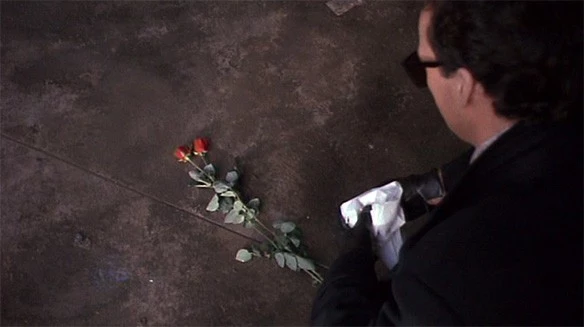
            Specifically, Burton uses flashbacks to give the audience an understanding of why Batman/Bruce Wayne is the way he is. Bruce Wayne witnessed the murder of his father and mother when he was a young boy and ever since then he has been troubled emotionally because of how traumatized he was at such a young age. In the picture above, the importance of that spot where the rose is placed on is revealed through Bruce Wayne's flashbacks of seeing his parents murdered there. Through flashbacks, the audience learns of this dark episode in his life and begins to connect the dots in understanding why he is so emotionally detached and why he may come off as frigid at times. He uses his dual identity of Batman to seek out the villains in Gotham City who threaten the well being of the city because he does not want other people to suffer like he did.
            Like Batman, Edward is the outcast of the suburban town in Edward Scissorhands. When the movie first starts, the audience only sees what is on the surface of Edward’s being. They see that he is lonely, quiet, expressionless, and always dressed in dark clothing. His hands of scissors add a fearful and scary element to his presence, but this soon changes as flashbacks throughout the course of the movie show that Edward was created by machines and eventually left alone by his creator when his creator died suddenly. The audience comes to know that Edward just wanted to be loved by someone, but instead was forced to live a lonely life. The moral of the story is to not judge a person by their looks because even though Edward may have a dark and scary appearance, the flashbacks indicate that he is like any other person who wants to be loved and cared for by others.

            Burton is very smart in the way that he uses flashbacks in his movies to make the audience understand the mentality and past of the outcast in his movies. Flashbacks teach the audience that there is more to a person that what it seems and that every person has a past that has shaped them into the person they are.

Friday, November 22, 2013

Martinez- Cannibalism the Musical


To understand Sweeney Todd’s want for revenge one must understand his life before he was “Sweeney Todd.” He was previously known as Benjamin Barker and had a loving family with a wife and daughter, but this happy life of his is snatched away by Judge Turpin and he never sees his family again. After 15 years, he finds out from Mrs. Lovett that his wife poisoned herself (which in the end we find out was all a lie) and now he feels like there is nothing left for him in the world other than to seek revenge against Judge Turpin. At first, the only person he cares about killing is Judge Turpin, but this changes as Perelli discovers his true identity and he kills Perelli because he fears being exposed. This quickly turns into a slippery slope of serial homicides when Mrs. Lovett gives him the idea of killing several people and using them to benefit her meat pie business, as they will use humans as her meat. The element of cannibalism in this film is to turn the metaphorical phrase of “man devouring man” into a more literal form, but still with the same metaphoric meaning. The cannibalism is a representation of the harsh and cruel life going on at this time. At this time, the economic system was all about mass production and the booming of business. There was no regard for the individual or the people working behind these businesses. In a sense, there was a loss of the importance of uniqueness and identity and society at this time. There was a strong emphasis on mass production, consumption and profit at this time and because of this there was no care for the individual, essentially everyone was looking out for their own self to survive. This is where the metaphoric meaning of “man devouring man” comes in. The meat pies in the film make this meaning literal when Sweeney Todd kills all of his customers and Mrs. Lovett uses them in her pies and other people eat them. She uses his multiple homicides to benefit her business and she and Sweeney do not care for the life that those people have. In the article, it discusses how this film is criticizing the “exploitative structures of capitalism itself.” Through the use of cannibalism in this film, the audience understands the economic corruption that was going on at this time and how mass production and profits were more important than the well being of the individual and how this time in economic history can be characterized as “man devouring man.”

Friday, November 15, 2013

Martinez-Big Fish


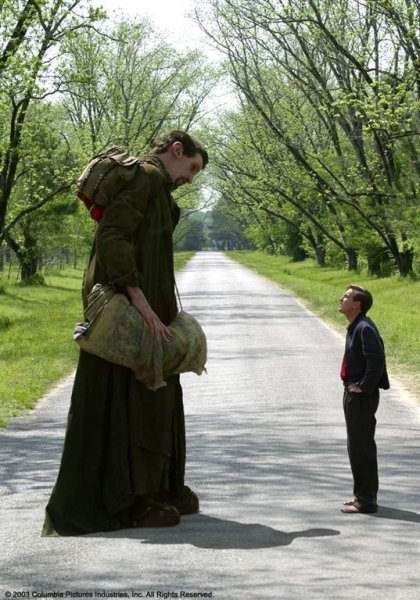
Edward Bloom merges with the dark and grotesque characters in the movie because he is accepts them for who they are and does not judge them. Edward is very “sunny” and happy, but even though he is an average citizen from his small town, he is not afraid to befriend people who are not like him. He demonstrates his acceptance of the giant when he and the giant agree to take a journey together and they walk alongside each other. Edward is very eager to become is friend and is not afraid of him. The giant’s large size and uncanny physical appearance does not put a wedge in Edward’s ability to befriend him. Another instance in which Edward befriends dark and grotesque characters is when he opens the door to the circus master’s trailer. The circus master turns into a wolf at night and almost killed Edward, but Edward was able to look at him as a person and not a scary being. He throws the stick for him to go fetch it, a sign of him not being afraid of the circus master even though he changes his form every night.


Edward came from a small town and in this small town there was not a wide variety of different kinds of people. When Edward left his small town, he wanted to find something new. He wanted to explore the outside world and experience people and places, which he had never seen before. The reason Edward is able to merge so well with the more grotesque characters is because the grotesque characters are not judgmental and they accept people for who they are. This is the opposite of his small town as his small town is afraid of anything outside of the norm. The small town wanted to kill the giant because he was so big and did not even take the time to understand or get to know him because they were so blinded by his physical appearance. Edward loves the way people can accept each other for who they are without having to be judged by prejudices or physical appearances. Burton is using Edward to send a message about how society should treat misfits. Edward is a regular human being from a small town, yet he is able to get past unusual physical appearances because he understands the value of humanity. Edward’s want for adventure and his curiosity allow him to merge with the dark and grotesque characters in the movie because he is accepting of people and places that are outside the norm.

Friday, November 8, 2013

Martinez- Planet of the Apes


The duality between civil liberties and slavery in Planet of the Apes helps develop the characters of the movie because depending on what side each character stands on with this conflict is how they unravel as a character. Ari, for example, is against the humans being treated so harshly and she says several times in the movie that she wants equality between apes and humans. One scene in particular, the scene in which one of the other apes who is in charge of holding the humans tells her that if her father wasn’t such an important man that they would kill her. When he says that she just stands there because she knows he is right. The reason she can be as vivacious as she is with her view that humans and apes should be equals is because she is immune from all punishments from authority. Because of this, she is a prominent character in the movie because she stands out in the eyes of the audience and the characters in the movie as a proud activist of equality between the two species.

A second scene that deals with the issue of civil liberties and slavery is when one of the guests at the dinner party trips one of the slaves and slams his head on the table. It is here that the audience sees that the humans are the slaves of the apes and the apes are their owners. This brings up the question of at what point do we start categorizing each other as “master” and “slave.” This makes the audience question under what conditions does one group of people become dominant over another group of people or species. This reflects directly back to the time when slavery was a common part of life here in the United States. Clearly one group of people claimed themselves superior over another group of people and made them become their slaves. Seeing the humans work for the apes as servants further emphasizes the difference between the world the Captain came from and the planet he is on now. The apes treat their human slaves in similar ways that humans in our world today treat other people or other animals. This makes the audience think about how dominant humans think they are above everything else. The enslavement of the humans signifies how much power the apes have over them and how weak the humans are. The apes have so much power and control over their land that the humans do not stand a chance next to them.

The duality of civil liberties and slavery in this movie makes the audience think about the importance of equality because one group of people should never enslave another species just because of their appearance.

Thursday, October 31, 2013

Martinez- Sleepy Hollow


Tim Burton’s Sleepy Hollow and Washington Irving’s short story The Legend of Sleepy Hollow are two very different stories shared by the same title. There is nothing wrong with this, Burton, just like Irving, has creative license to make the movie in the way he wanted. Both the story and the movie are creative and interesting in their own way. In my personal opinion, I believe that Burton is using the title and the characters to enhance this horror story and turn it into something creepier that Irving’s. One of the few similarities is the Headless Horseman- in both cases he is a German Hessian. Irving’s story has a dread that hangs throughout the tale, but it is nowhere as creepy as Burton’s movie. Burton’s depiction is much more eerie and horrific, especially through his use of dark colors and contrasts with pale coloring. In my opinion, he took Irving’s eerie-ness and turned it up a notch to fit his artistic style. The depiction of Irving’s characters is very different in the movie that in the story. In the short story, Ichabod Crane is a schoolteacher and in the movie he is a detective from New York. What Burton did take away from the original Ichabod was how Ichabod was easily scared and spooked. Both the story and the movie he jumps at anything and gets scared easily. I think Burton did this because it is comedic that a detective would be scared and spooked so easily. One would think that someone assigned to a murder investigation would not be so easily scared of blood. In both the short story and the movie there is the element of magic and supernatural practices. However they are both used differently in both accounts. In Irving’s story, Ichabod is a master of witchcraft. This is totally different from the movie where Ichabod does not believe in magic or the supernatural. The rest of the community of Sleepy Hollow had told Ichabod several times upon his arrival that the murderer was the Headless Horseman but he never believed it until he finally saw him for himself. Burton takes the character of Ichabod Crane and witchcraft from Irving’s story and dramatically changes them in his interpretation because he believed he could make a creepier and scarier depiction of the story of Sleepy Hollow. Katrina van Tassel is another main character from Irving’s story that Burton takes away and “tweaks” in his own way. In the original story Brom did not bewitch her, nor was she attracted to Ichabod. I believe Burton made Katrina have an attraction to Ichabod because he knows that an audience loves a little romance or something of a love story between two people. He used this romance to keep his audience interested in his movie. I do not think it is a bad thing that Burton strayed away so far from the original story; rather it gives more attention to both the story and the movie. Audiences are fascinated by both accounts of the legend of Sleepy Hollow because of how differently each is portrayed.